

Alumni Edition 19 - August 2018
Kenneth ‘Ken’ Alan Archer AM (born 17 January 1928) is a former Australian cricketer and broadcaster. He was educated at the Anglican Church Grammar School. An opening batsman, he played domestic first-class cricket for Queensland for 10 years, from 1946–7 to 1956–7. He played in five Tests for the Australian cricket team in 1950 and 1951. His younger brother Ron Archer played 19 Tests for Australia between 1953 and 1956. Archer toured to South Africa in 1949–50, but was not selected for the Test team. He made his Test debut in the second test (after a sixth consecutive 12th man pick) of the 1950–51 Ashes series against England.
Archer (pictured right, walking out for the Sydney Test against the West Indies in 1951) worked as a science teacher during his playing career, but switched to broadcasting in 1954 for Brisbane radio station 4BC. He later became chief executive of the Commonwealth Broadcasting Corporation. Archer was named a Member of the Order of Australia for services to the media, and was awarded the Australian Sports Medal for his cricketing achievements.
FDC Constructions are one of the proud sponsors of University of Queensland Cricket

Your first memory of UQCC?
Playing against UQCC in the then annual GPS XI v Uni fixture back in 1943. I did that again in ’44 and ’45. Those three matches were all played at the Gabba. From 1942, the minimally developed St Lucia site served as the headquarters of the Allied Land Forces under the command of General Blamey.
(I’m aware the GPS representative side now plays against the Wanderers, but don’t know when the switch-over occurred. It may well have related to Lew Cooper.)
Your best Uni cricket memory?
Lots of enjoyment. UQCC 1st XI didn’t win too often back then, but we found many ways to enjoy our cricket.
Your best memory of WEP?
My early memories of Wep are mostly baseball related. During my first years with Uni, Wep played mostly in Clem’s B-grade team. He must have helped Clem win a premiership or two and thus didn’t get promoted. The UQ Baseball Club, newly re- established in 1946, had significantly fewer aspirants than the cricket club, and Wep became our regular first baseman. I think it’s fair to say neither his catching, throwing or hitting talents ever quite reached the level of his infectious enthusiasm, which happily never
Who was the best net bowler or batsman you ever saw?
Without a doubt Arthur Morris. He had gone to the St George Club in Sydney as a left-hand ‘chinaman’ bowler of promise. About the same time, Ray Lindwall arrived as a promising batsman. The great Tiger O’Reilly, then captain of St George, fairly quickly had Arthur opening the batting and Ray opening the bowling — to the great future benefit of Australian cricket. Indeed, Arthur & Ray were the two major contributors to the invincibility of ‘The Invincibles’. They both retained much of their initial expertise. However, strong self-belief is a prerequisite for all champions, and Arthur appeared to focus all of his on his batting. Sometimes nearly unplayable when bowling in the nets, Arthur 'went to water' whenever called on out in the middle; the calls thus becoming rarer. For younger readers (and these days that’s nearly everybody), I should comment that no superstar has ever so effectively kept their self-belief under wraps and away from public exposure than Arthur.
What was the strangest dismissal you ever saw?
I found a wide variety of ways to get out but I suspect they’ve all been replicated by now. I think the strangest dismissals have mostly come since the advent of technological assistance for umpires. I still find it odd to see batsmen being recalled from the boundary when the fatal delivery has been determined (after lengthy reviews) to be a no-ball. Was it England’s Ian Bell who got recalled an adjournment or two after he’d been given out?
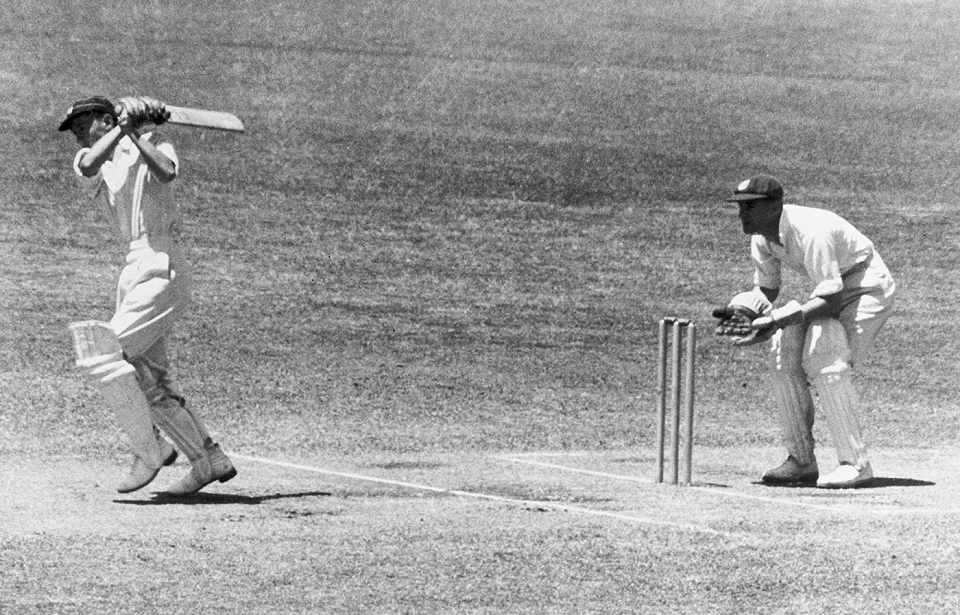
Ken Archer batting in a Shield game in 1950
Which Old Boy had the best success with the opposite sex?
It would have to be an Old Boy at least a generation or two behind mine. A brief social history may be required to explain why. In the decade and a half following World War II, Australian social culture continued to observe the post-Depression era’s strict moral rules, strongly enforced by then still powerful religious institutions and by the community generally. Premarital sex was very near the top of the sin-list; out-of- wedlock pregnancy and/or a ‘shot-gun wedding’ meant social disgrace. Fear usually managed to suppress lust. The ‘pill’ was approved for sale in 1960. It very quickly created the swinging ’60s, a sexual revolution and a less ’stitched-up' society. By that time I was a happily married father- of-two, and thus a dispassionate, analytical observer rather than a participant in this dramatic social change. Perhaps I should point out to the quizmaster that more recent social changes involving gender fluidity (and half the alphabet) may require him to modify this question to provide greater clarity as to exactly where opposite may be.
Best away trip – Intervarsity/country/tour?
I greatly enjoyed the UQCC annual visits to Armidale to play the then New England College of Sydney University over the Easter weekend. They were organised by Clem and ‘Smithy’ (Armidale’s Professor of Mathematics) who were both cricket and tennis tragics of very high order. I suspect they actually arranged the two-day cricket match as an excuse for their personal Easter Sunday morning, pre-cricket and fiercely contested tennis match. I should add that my six-month tour of South Africa in 1949–50 was an incredible experience — actually a broad range of experiences. Apart from 5 x 5-day Tests, we played only one 3 or 4 day match each week, so enjoyed plenty of leisure time. That certainly sharpened up my golf and squash and, as a more lasting legacy, my social conscience. Apartheid was not then official policy, but it was universally practised. The nation’s economy was heavily dependent on the ‘slave labour’ provided by indigenous Africans.
The serious social tensions, however, went far beyond black and white. A wide range of ethnic, religious, socio-economic groups were all distrustful of one another. Probably the only common ground was that the more significant groupings: Boers, Brits, Jews, Coloureds and the major African tribal groups all hated the Indians! It made me feel very fortunate to have been given the gift of life in Australia. My subsequent travels have generally reinforced that feeling. I think South Africa’s current situation, while less than ideal, is a remarkable achievement. So is the significant black middle-class in the USA and ever growing middle-classes in China, India and some other S-E Asian nations. I believe that overall our imperfect human civilisation is still improving.
Funniest team mate?
I’ll pass. There were plenty but I can’t find a winner.
Best bowler faced?
Not difficult. It’s Ray Lindwall with Alec Bedser a close runner-up. They were both more than good enough to get me out which, all too often, they did. Ray gets the top slot because he was genuinely quick and, in those ‘unprotected' days, potentially lethal. Inside edging him onto one’s body produced much more pain than the medium-quick Alec. Funny how some ‘names’ persist yet others don’t. Ray lost 6 prime years to the war but was clearly the world’s dominant fast bowler from 1946 to 1953. For some reason he has been less remembered than his fellow opening bowler Keith Miller. Bill Johnston, the third member of one of Australia’s greatest ever attacks, has also dropped off the page a bit. It was a very well balanced attack in many ways. Without in any way denying or diminishing Miller’s extraordinary talent and flair, it frequently seemed 'back in the day' that Ray and Bill did 80% of the bowling, took 90% of the wickets while Keith got all the publicity.
Best batsmen bowled to?
I bowled quite a few overs for Queensland, nearly all of them before I became captain! I think my handful of wickets included both Morris and Harvey (probably in meaningless 4th innings) so they are on the list. I know I got the wicket of a youthful Benaud, but despite his 2000 Test runs he doesn’t even make the 'best list’. Everton Weekes, a great player and a great bloke, Ken Mackay and I bowled to Everton Weekes in the Gabba nets in 1951 while his Caribbean team mates were playing a game against North Queensland. We quickly became aware of his exceptional talent. We didn’t need to look at the statistics to know he was a ‘great’.
Biggest hit seen?
Queensland’s bowling hero in the early post-war era was Len Johnson. Not that big physically, but amazingly strong, Len once hit one right over the old Gabba Member’s Stand roof into Vulture St. My brother Ron, playing for Souths against us at St Lucia, caused Kevin Duffy much angst by hitting him a long long way into the then timbered country to the north. We teased Kev by claiming had it been the other end it would have been in the river. We thought these were big hits and, given the toothpicks we batted with back then, they were. Who knows how far they’d have gone with today’s big clubs?
Best catch seen?
Don Tallon was a wicket-keeping genius. Cat- like reflexes, the softest pair of hands, impeccable balance and footwork enabled him to do things I’ve never seen matched. The first time Queensland ever played West Australia in Perth, Colin McCool was bowling and left- hander Wally Langdon came on strike. I’d been in the covers for the right-handed batsman and moved around to the behind square-leg ‘top-edge’ slot. McCool bowled a full-toss outside leg stump which Wally attempted to sweep. Don was crouched low as the ball would have half-volleyed into his gloves. From my ‘dress-circle’ vantage point I saw the ball land on the top edge of the bat and pop up sharply on its way to the fine leg fence. Don somehow rose with it, got a glove above and behind his shoulder to parry the ball upwards and comfortably caught his own rebound. I couldn’t believe anybody’s reflexes were that quick. To make it even more memorable, the umpire gave it not out! So I guess, technically, it wasn’t a catch at all but it’ll do until a better one comes along.
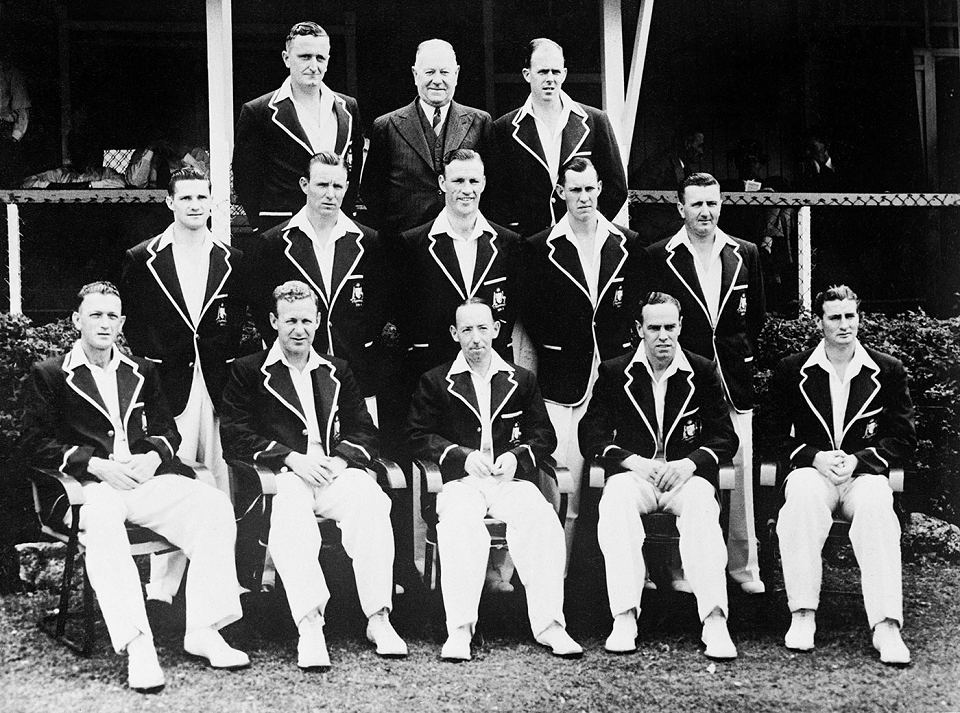
Australian team 1950 - Ken Archer middle row 4th from the left
Easiest catch you ever saw dropped?
I played for Queensland for 10 years and although I caught a few, I did drop one. To the best of my recollection it was the only one. It wasn’t the easiest, but it was catchable and, for my sins, it was from Alan Davidson off Colin McCool’s bowling. Colin was a bowler who liked to be ‘cranky' and, despite my having saved him many runs and caught all the other chances, he gave me a decent roasting out there in the middle for this misdemeanour. Davo, as many people now know, has a photographic memory of his entire cricket career, and is easily provoked into a slide show. He’s got my ‘drop’ on his highlights reel. I’ve probably dropped him so often by now it must be approaching infinity.
Toughest opponent on cricket field?
Lots of genuine competitors over the years. Len Hutton took the game very seriously indeed; didn’t give any quarter as a captain and batted as if his life depended on not getting out. Phil Ridings, long-term Captain of South Australia, was a very competitive guy on the field and a pleasant companion off it.
Best cricket commentator?
Richie Benaud
Who is your hero?
Victor Trumper has always been my cricketing hero. My father plied me with stories of his talent and charm, but I later came to realise that Victor was the original template for Australia’s 20th century batting greats. That ensured that most of our top-order batsmen were of an attacking mindset and meant we always sought to win games rather than save them. Bill Brown (Queensland's batting star of the 1930s, born in Toowoomba even if imported back from NSW) was my childhood batting hero. I often caught a tram to the Gabba after school and headed for the splintery old wooden seats on the East Brisbane School side of the ground in the hope that Bill would be batting and performing his graceful leg glances.
Which six people would you want to have to dinner?
Since my early teens I’ve had an abiding interest in scientific endeavour, especially facts and theories about the nature of the universe. I’d love to pick these brains even if it required some exhuming. In chronological order, no rankings. Aristotle, Leonardo Da Vinci Galileo, Galilei, Isaac Newton, Marie Curie, Albert Einstein, Stephen Hawking*
(* I think we’ll allow the oldest living Test cricketer to sneak an extra in there)
First car?
A 1952 Hillman Minx
First job?
Acting curator of UQ Ovals 1 & 2. This was the first time anybody paid me, although Clem Jones wasn’t over-generous and by the time I paid my tram and West End ferry fees on 4 days, a week there wasn’t much left to pay for the shoe-leather on that long walk to the ovals. I still retain a clear mental picture of the area in December 1945. The substantial 270 acre St Lucia site, acquired with donations from the Mayne family, was still undeveloped apart from the partially completed Great Hall and Chemistry Building. They were taken over as the Allies Land Forces Headquarters by General Blamey in 1942. Some temporary buildings had been erected on the northern and eastern parts of the site by the Army. The ovals themselves sat in relatively pristine bushland on the southern side. The army had been using the ovals for recreation and sporting events. The war ended in August 1945 but the Army remained in charge of the site. They had agreed to permit the use of the ovals for the QCA competition. Clem had co-opted me to make them playable through
December & January until he could find a permanent curator. At first sight this appeared to pose some difficulties, especially as the tools of trade were inadequate and unduplicated. Somehow, we got by and the pitches were satisfactory. Dragging the only roller between ovals — especially the uphill journey back to No 1 — remained a physical challenge for this then-skinny kid throughout those hot months.
What is your all time Test Match World XI?
My first attempt produced a long list and I couldn’t find the courage to cull it back to eleven so I changed the question. Here’s my World XI pick from players I played with or against. I have not considered Bradman although I played with him in the Oldfield-Kippax testimonial match in February 1949. He came back from retirement, swelling the gate money considerably for his old team-mates.
Arthur Morris, Len Hutton, Neil Harvey, Denis Compton, Everton Weekes, Frank Worrall, Keith Miller Don Tallon, Ray Lindwall, Alec Bedser, Sonny Ramadhin
Here’s a post-1955 World XI
Barry Richards, Sunil Gavaskar, Sachin Tendulkar, Viv Richards, Brian Lara, Garfield Sobers, Adam Gilchrist, Malcolm Marshall, Wasim Akram, Shane Warne, Dennis Lillie, Ricky Ponting (12th man) Glenn McGrath (13th man)
Even then I couldn’t fit in Graham Pollock, Joel Garner or any of those other scary West Indian quicks; nor a solitary Pom. Joe Root will definitely be in the post-2000 team.

Join the cricket network to promote your business and expertise. Make it easy for people to search and find the people and services they need through people they know and trust.
Join the network